

When World War II began in 1939, the United States produced fewer than 3,000 military aircraft. By 1944, that number had surged to 96,000 a year, more planes in a single year than Japan built over the entire war. By the end of the conflict, American factories were producing two-thirds of all Allied military equipment. American troops fought WWII. American manufacturing won it.
That industrial base no longer exists.
Before Russia invaded Ukraine, American factories produced about 14,000 155mm artillery shells a month. The 155mm round is not a simple product, but it is a known one. The manufacturing processes are well understood, the design hasn’t changed dramatically in decades, and it is orders of magnitude less complex than a World War II-era bomber. After the invasion, the Army committed nearly five billion dollars to scale production, targeting 100,000 rounds a month by October 2025. Three years later, output sits around 40,000. Russia produces roughly six times that, outpacing the entire NATO alliance combined.
In war games simulating a conflict with China over Taiwan, the US expends its inventory of long-range anti-ship missiles within the first week. Stockpiles of long-range munitions run dry within three. We cannot produce what we need, fast enough, to sustain a fight against a peer adversary.
The Invisible Foundation
But the shells and the missiles are downstream. Trace the problem back far enough and you arrive at a place most people have never thought about.
Machine shops.
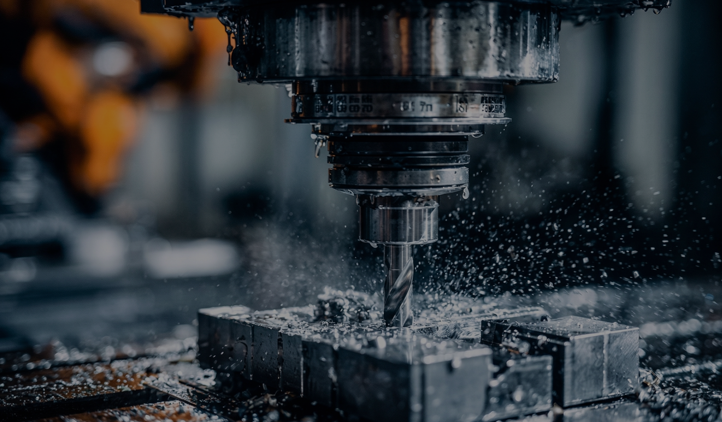
Every missile, every fighter jet, every submarine contains thousands of precision-machined metal components. Machine shops turn raw blocks of aluminum, titanium, and steel into those parts. The machined-parts market in the United States is worth fifty billion dollars a year. It is the base layer of American industrial capacity, and it is failing.
There are 17,000 machine shops in America. China has roughly 200,000. China’s shipbuilding capacity is estimated at 232 times that of the United States. In 2024, a single Chinese state-owned shipbuilder produced more commercial vessels by tonnage than the entire US shipbuilding industry has built since World War II.
A Forgotten Generation
When manufacturing started getting expensive in the 1970s and 1980s, America faced a choice: automate or outsource. It chose to outsource. Entire sectors relocated to China and Southeast Asia. The companies that stayed optimized for cost, not capability.
The damage went beyond lost factories. Millions of Americans who came of working age during the offshoring era never learned to manufacture anything. Trade schools and apprenticeship programs withered or shut down. The skills pipeline didn’t thin out. It collapsed.
Now there is real momentum behind reshoring. But the workforce to support it doesn’t exist. Training a machinist takes up to four years. Not enough people are entering the trade. A quarter of the existing workforce is at or near retirement age, and when they leave, they take decades of knowledge with them.
You can bring the work back. You can’t conjure the people to do it.
A Market That Resists Scale
The structure of the industry makes everything harder. The largest fifty machine shop companies hold just ten percent of total industry revenue. The other ninety percent is spread across thousands of small, independent operations, each running a unique patchwork of machines, software, and institutional knowledge that lives in the heads of individual operators.
CNC machines in a typical shop sit idle sixty percent of the day. Not because there is no work. Because there are not enough machinists to run them, and the manual processes around setup, material handling, and job scheduling cannot keep the machines fed. Millions of dollars of equipment, dark for most of every shift. And because each shop is small and isolated, there is no mechanism for improvement at scale. No network effects. No compounding advantage. Just thousands of tiny operations, each reinventing the wheel alone.
The usual response is to build bigger. But mega-factories serve less than ten percent of the machined-parts market. The other ninety percent is high-mix, low-volume work that demands flexibility, not cathedral-scale production lines.
And you cannot apprentice your way out. Modern defense manufacturing requires specialized labor, proprietary tooling, and years of qualification. You cannot retrain a generation of workers overnight.
The only viable path is to climb the technology stack. The labor market cannot close this gap. Robotics and automation can.
Even Platforms
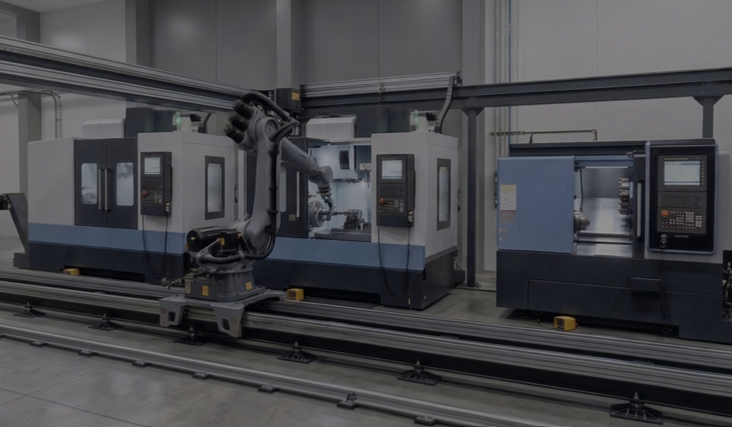
Even Platforms is building a new kind of machine shop: modular, standardized facilities controlled by software from the ground up. Every facility runs the same floor layout, the same machines, the same procurement processes. This eliminates the variation that makes traditional machine shops impossible to replicate.
Robotic systems handle material loading, unloading, and part transfer, tasks that consume roughly forty percent of a machinist’s time and are the leading source of error. Machine monitoring, another forty percent, is replaced by sensor data fed into our autonomy layer, EvenOS, which controls order routing, production sequencing, and every operational decision that introduces randomness in a conventional shop. The result is lights-out production, twenty-four hours a day, seven days a week.
For the first time, you can open a new machine shop in a new city and know it will produce parts at the same quality as every other shop in the network. Our model is repeatable by design.
The Learning Loop
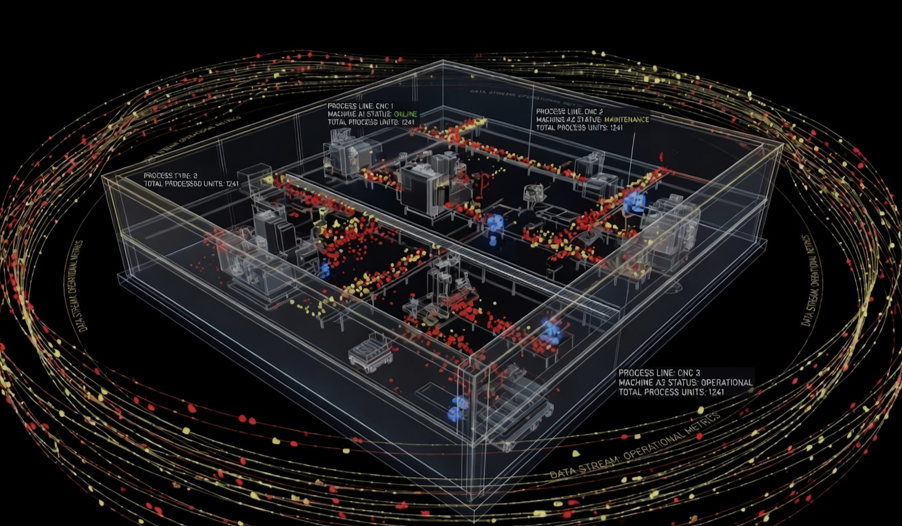
That repeatability creates something no collection of independent shops can replicate: a compounding learning loop. Every machine and robot in our network generates data that a traditional shop never captures. We feed that data into EvenOS, surface anomalies, and push fixes across the entire network automatically. Every part we produce becomes a data point that improves all facilities simultaneously.
A spacer comes back out of tolerance. EvenOS traces the failure through vibration data to a worn cutting tool that degraded under specific conditions of spindle rate and feed. The system routes an instruction to the floor: swap the tool, scrap the part. One lesson, stored centrally, applied everywhere. That knowledge compounds over time and across locations in a way that a standalone shop, no matter how talented its machinists, simply cannot match.
Quality does not hold steady as we scale. It gets better.
Built for Peacetime. Ready for Wartime.
Decades of lean manufacturing and just-in-time supply chains have eliminated every ounce of slack from the American industrial system. CSIS has found that replacing current weapon inventories would take years, even at surge production rates. During the Cold War, the ability to surge was a core element of US defense strategy. That capacity has atrophied almost entirely.
A distributed network of standardized, software-controlled machine shops changes this. In peacetime, our facilities produce precision components for aerospace, automotive, medical, and energy customers. The network stays busy, the economics work, and the capability stays sharp. When demand surges, the same architecture that routes commercial orders can reprioritize and redistribute defense work across hundreds of facilities rather than overwhelming a single supplier.
Congress recognized this need in the FY2026 NDAA, which authorized the creation of a Civil Reserve Manufacturing Network: commercial manufacturing that can be inventoried, mapped, and activated during wartime. Even Platforms is built for exactly this. The same system, serving the commercial economy on Tuesday and surging for national defense on Wednesday.
We are building 10,000 machine shops across the United States, on a modular footprint designed to scale when the country needs it most. The industrial base does not have to be fragile. We intend to prove that.